
7 Common Stock Market Mistakes Beginners Must Avoid
I have a confession. When I first started investing, I lost $200 in one week. Why? Because I made a stupid mistake. I listened to a rumor and rely on it. At the end of the day the price suddenly dropped, and I learned a hard lesson.
I don’t want you to make the same mistake. Investing is a great way to build wealth, as we discussed in our Stock Market for Beginners, but it can also be risky if you treat it like a casino.
Learning from failures is even more important than studying success stories. In stock trade, minimizing losses is more crucial than maximizing gains.
Here are the 7 most common mistakes beginners make—and how to fix them.
1. Trying to “Time the Market”
Beginners always try to guess the future. They say, “I will wait until the price drops to the bottom, then I will buy.” Spoiler alert: You can’t do it. Even professionals cannot do it.
If you waited for the “perfect bottom” during the COVID crash in 2020, you probably missed it because the market recovered incredibly fast.
The Fix: Use “Dollar Cost Averaging.” Just invest the same amount of money every month on the 1st, no matter if the market is up or down.
For your reference, here is the S&P’s past performance.
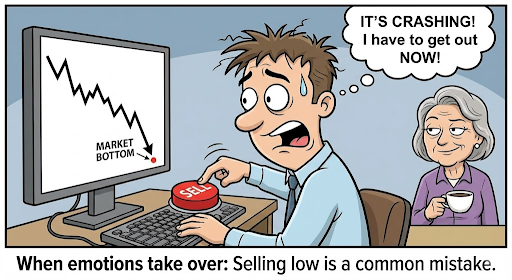
2. Panic Selling
When the stock market drops, it is scary. You see red numbers on your screen. Your brain screams, “SELL NOW before I lose everything!”
Let’s look at history. In March 2020, the S&P 500 dropped over 30% in a few weeks. People panicked and sold their stocks. But by August 2020, the market was back to all-time highs. The people who sold lost money. The people who held made a lot of money.
The Fix: Stay calm. Corrections are normal. History shows S&P market always recovers eventually.
This means putting all your money into ONE company or ONE sector. Imagine you put all your money into tech stocks in 2021. In 2022, the tech sector crashed hard. Your portfolio would be down 50% or more.
The Fix: Diversify! Don’t just buy tech. Buy energy, banks, healthcare, and consumer goods. As mentioned in [Link to Post 2: ETFs vs. Individual Stocks], using ETFs is the easiest way to fix this.
4. Trading Based on Emotions Greed and Fear are your enemies.
Some people buy stock just because it went up yesterday.
Fear: Selling just because you read a scary news headline.
The Fix: Make a plan before you buy. Write down: “I am buying this stock because…” If the reason hasn’t changed, don’t sell.
5. Ignoring Fees Fees are the silent killer of wealth.
Commissions: If you pay $10 every time you buy a stock, and you only invest $100, you are already down 10%!
MER (Management Expense Ratio): Some mutual funds in Canada charge 2% fees. Over 25 years, a 2% fee can eat up nearly 40% of your total gains.
The Fix: Use low-cost apps like Wealthsimple or Robinhood. Look for ETFs with MERs below 0.1%.
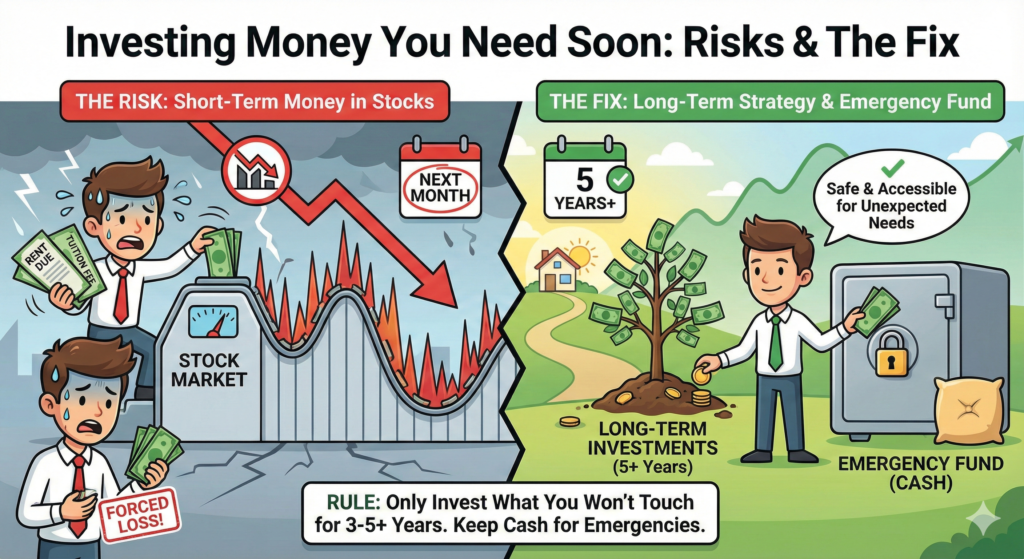
6. Investing Money You Need Soon
The stock market is for long-term money (5+ years). Do not invest your rent money. Do not invest money you need for a tuition fee next semester. If the market drops 20% right before you need to pay rent, you will be forced to sell at a loss.
The Fix: Only invest money you won’t touch for at least 3-5 years. Keep a separate “Emergency Fund” in cash.
7. Following the Hype (The “Meme Stock” Trap)
My friend said this crypto will skyrocket!” “TikTok says this stock is going to be $1,000!”
We all saw what happened. A few people got rich, but basically millions of people bought at the top and lost their savings when the hype died. Buying based on hype is gambling, not investing.
The Fix: Do your own research. Look at the company’s profit and debt. If you don’t understand the business, don’t buy it.
Conclusion: Be Smart, Be Patient
Investing is not a sprint; it is a marathon. The market will reward you if you are patient. If you can avoid these 7 mistakes, you are already ahead of 90% of new investors. Keep your emotions in check, diversify your portfolio with Canadian and US stocks, and think long-term.
Ready to fix your portfolio structure? Start creating here to see more resources on building a safe financial future.