Stock Market for Beginners: Your Step-by-Step Guide to Investing
Why Should You Invest?
Before we talk about how to invest, let’s talk about why. Some people think, “I will just keep my cash in a piggy bank. It is safe there.”
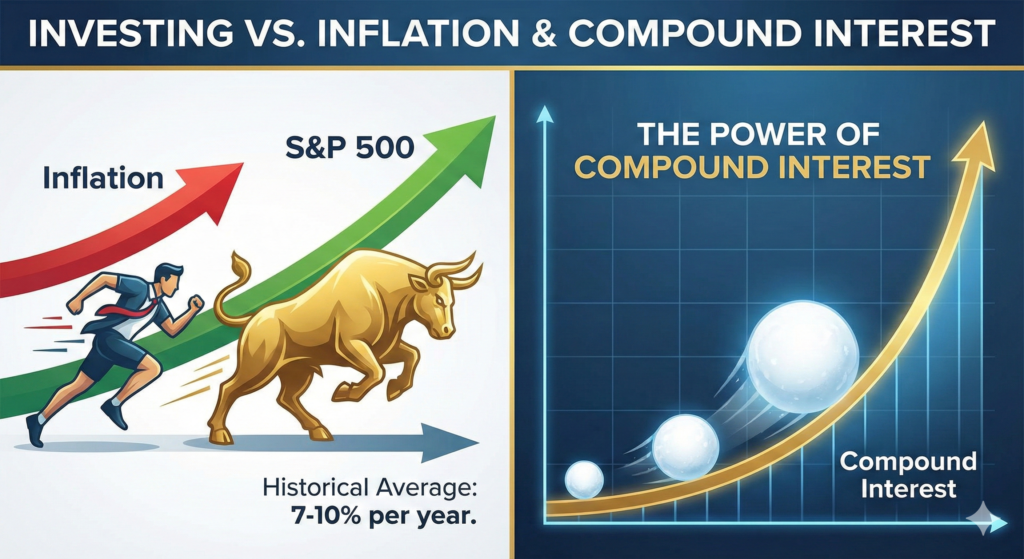
But is it really safe? No. Because of Inflation.
Inflation means that things get more expensive every year. Your money buys less today than it did yesterday.
- Think about housing: Look at real estate prices in cities like Toronto or Vancouver. A house that cost $500,000 ten years ago might cost over $1.5 million today.
- Think about groceries: Remember when a dozen eggs cost $2? Now, in many US and Canadian cities, you might pay $5 or $6.
If you keep your money in cash, it loses value every single day.
Investing in the stock market helps you beat inflation. Historically, the S&P 500 (the top 500 companies in the US) goes up about 7-10% per year on average. This is the power of compound interest.
What is a Stock?
Simple explanation: A stock is a small piece of a company. When you buy a stock of Apple (AAPL), you don’t just own a piece of paper. You become a partial owner of the company that makes iPhones.
- If the company makes money: The stock price usually goes up.
- If the company loses money: The stock price usually goes down.
Your goal is to buy good companies—like Microsoft, Costco, or Amazon—that will continue to grow and sell products in the future.
How to Start Investing in 4 Steps
Here is your simple checklist to get started today.
Step 1: Open a Brokerage Account
You need a place to buy and sell stocks. This is called a “brokerage account.” Today, it is very easy. You can use apps on your phone.
For Canadians:
- Wealthsimple: Great for beginners, $0 commission fees.
- Questrade: Good for buying ETFs.
- Big Banks: TD Direct Investing or RBC Direct Investing (reliable, but higher fees).
- Important Account Types: You should open a TFSA (Tax-Free Savings Account). If you make profit in this account, you pay $0 tax to the CRA. It is a magical tool for building wealth!
For Americans:
- Robinhood or Webull: Very user-friendly apps.
- Fidelity or Vanguard: Great for long-term retirement savings.
- Important Account Types: Look into a Roth IRA. Like the TFSA, it allows your money to grow tax-free.
Step 2: Decide Your Budget
You do not need $1,000 to start. You can start with $50 or $100. For example, if you skip two Starbucks lattes a week, you save about $10-$15. That is $60 a month. If you invest $60 a month for 30 years at a 7% return, do you know how much you will have? Over $70,000. That is the power of starting small.
Step 3: Choose Your Investment Style
This is the big question. Do you want to pick individual companies? Or do you want to buy a basket of many companies at once?
Individual Stocks: You buy Tesla because you believe in electric cars. High risk, high reward.
ETFs (Exchange Traded Funds): You buy an ETF that holds Tesla, Ford, Toyota, and GM all at once. Lower risk, steady growth.
Not sure which one to pick? We wrote a full guide comparing these two strategies. Read our post on ETFs vs. Individual Stocks to decide what fits your personality.
Step 4: Buy and Hold
This is the big question. Do you want to pick individual companies? Or do you want to buy a basket of many companies at once?
- Individual Stocks: You buy Tesla because you believe in electric cars. High risk, high reward.
- ETFs (Exchange Traded Funds): You buy an ETF that holds Tesla, Ford, Toyota, and GM all at once. Lower risk, steady growth.
(Internal Link Opportunity)
Not sure which one to pick? We wrote a full guide comparing these two strategies. Read our post on ETFs vs. Individual Stocks to decide what fits your personality.
Once you buy your stock, do not check the price every hour. That will make you stressed. Investing is a long-term game. Think of your stocks like a bar of soap. The more you touch it, the smaller it gets (because of trading fees and stress). Buy it and forget about it for a while.
Conclusion: Start Today
The best time to plant a tree was 20 years ago. The second best time is today. The same is true for investing. Don’t wait for the “perfect” moment. The market will always have ups and downs, but over time, it goes up.
You can start from checking your favorite company’s stock here
Put in a small amount of money, and watch it grow. Do you have any questions about opening your first account? Let me know in the comments below, or check out our about us to learn more about my journey!