
ETFs vs. Individual Stocks: Which Strategy Fits Your Portfolio?
ETFs vs. Individual Stocks: Which Strategy is Best for You?
Buying an individual stock means you are betting on ONE specific company. To illustrate, you buy shares of Lululemon (LULU).
So, you opened your brokerage account. Congratulations! Now you are staring at the screen, and you see thousands of options. Should you buy Amazon? Should you buy Shopify? Or should you buy something called “VFV” or “SPY”?
This is the most common question for new investors. It can feel overwhelming because there are so many choices. In my previous post, Stock Market for Beginners, we talked about the basics of opening an account. Today, we will compare the two main strategies: ETFs and Individual Stocks.
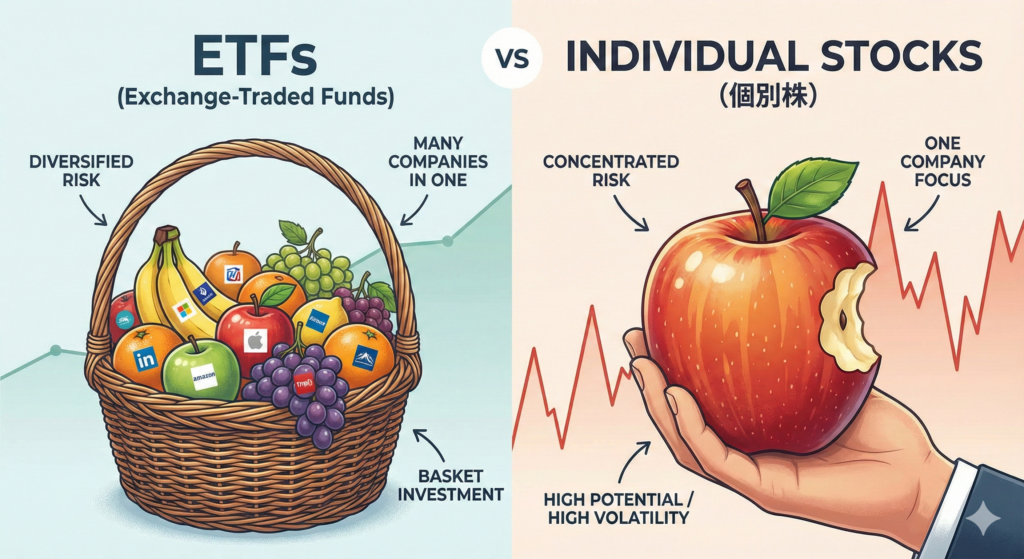
What is an Individual Stock?
Buying an individual stock means you are betting on ONE specific company. For example, you buy shares of Lululemon.
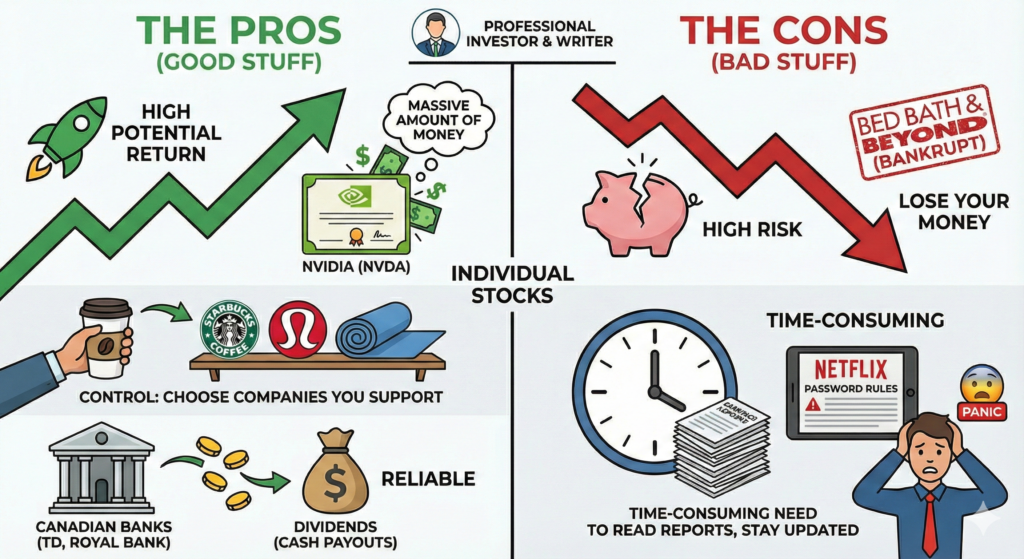
The Pros
High Potential Return: If you bought Nvidia (NVDA) a few years ago before the AI boom, you would have made a massive amount of money. Individual stocks can double or triple in value quickly.
Control: You choose exactly which companies you support. If you love coffee, you buy Starbucks. If you love yoga, you buy Lululemon.
Dividends: Some companies, like Canadian banks (TD Bank or Royal Bank), pay very reliable dividends (cash payouts) to shareholders.
The Cons
High Risk: Unfortunately, if that company has a bad year, or goes bankrupt (like Bed Bath & Beyond), you lose your money.
Time-Consuming: You need to read earnings reports. For example, when Netflix changed its password-sharing rules, the stock moved a lot. If you didn’t know the news, you might have panicked.
What is an ETF?
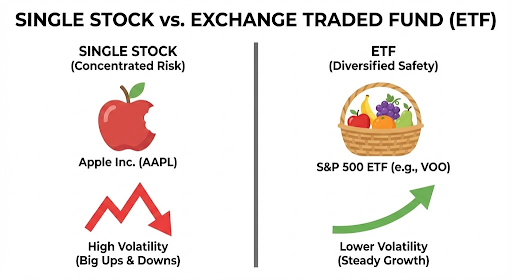
ETF stands for Exchange Traded Fund. Think of an ETF like a fruit basket. Instead of buying just one apple, you buy a basket that has apples, bananas, oranges, and grapes.
For instance, If you buy an “S&P 500 ETF”, you are buying a tiny piece of the 500 biggest companies in the US (like Apple, Microsoft, Google, Amazon) all at once.
Popular US ETFs: VTI, SPY, QQQ (Tech focus).
Popular Canadian ETFs: VFV (S&P 500 for Canadians), XIC (Total Canadian Market).
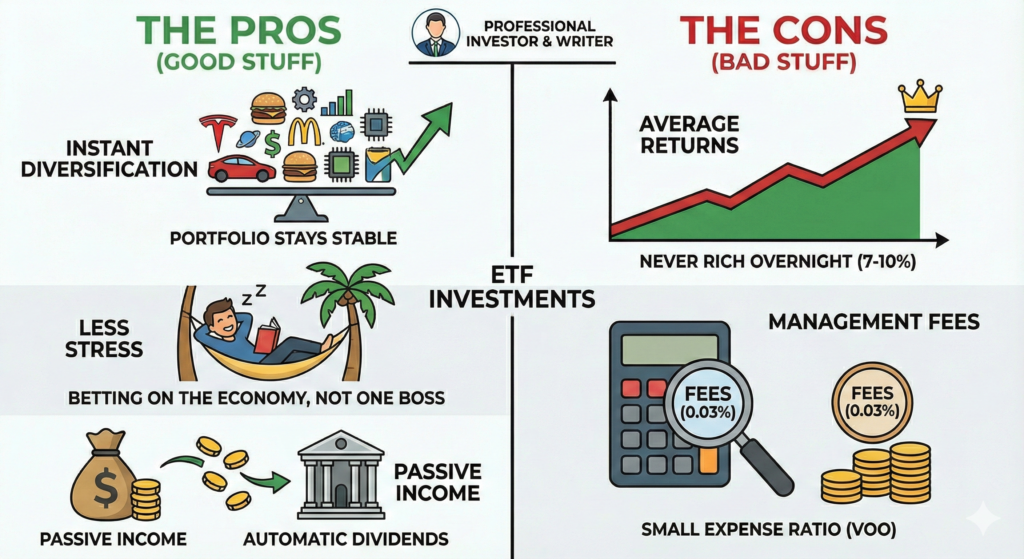
The Pros
Instant Diversification: First you own hundreds of companies. If Tesla drops 10%, but McDonald’s goes up 10%, your portfolio stays stable.
Less Stress: Furthermore, you don’t need to check the news every day. You are betting on the economy, not one boss or one product.
Passive Income: Many ETFs pay dividends automatically.
The Cons
Average Returns: On the other hand you will never “get rich overnight.” You will get the average market return (usually 7-10%).
Management Fees: Some ETFs charge a small fee (Expense Ratio). However, modern ETFs like VOO charge very little (0.03%).
Comparison Table
Which One Should You Choose?
Feature | Individual Stocks | ETFs |
Risk Level | High | Low to Medium(Depends on the ETF) |
Effort Needed | Yes | Not much |
Potential Reward | High-risk, high-return | Low-risk, low-return |
Example | Tesla (TSLA) | S&P 500 (VOO) |
Best For | Active Traders | Passive Investors |
There is no “right” answer, but here is my advice based on your lifestyle:
Choose ETFs if:
You are busy with work or school and don’t want to study charts.
Ideally, you want to save for retirement safely in your TFSA or 401k.
Finally, avoiding stress and sleep well at night.
Choose Individual Stocks if:
You love reading financial news and following trends (like AI or EVs).
It is okay with losing some money for a chance to win big.
Also, you have strong convictions about specific brands.
My Recommendation: The “Core and Satellite” Strategy
- You don’t have to pick just one. Many successful investors use a hybrid strategy.
- The Core (80%): Put most of your money in safe, broad-market ETFs (like the S&P 500). This protects your future.
- The Satellite (20%): Use a small amount of “fun money” to pick individual stocks you love.
Conclusion
Investing is personal. The most important thing is to pick a strategy that lets you stay consistent. However, whether you pick stocks or ETFs, there are some dangerous traps you must avoid. Wanna learn how to open the account? Please open here Before you make your first trade, please read our guide on 7 Common Stock Market Mistakes. It might save your wallet from a crash!